Pearson Edexcel · GCSE · Mathematics
Course version: 1MA1 · Version from Mar 2026
Number - Structure and calculation: apply systematic listing strategies (Foundation tier)
Turn a guessing game into a reliable method for finding every possibility exactly once. This Foundation guide shows you how to organise lists, avoid repeated or forbidden outcomes, and turn clear working into exam-ready answers.
- 11 min read
- 3 worked examples
- 6 practice questions
- 10 key terms
Try the lesson
The start of the Number - Structure and calculation: apply systematic listing strategies (Foundation tier) lesson, made from checked teaching notes for this specification point.
Have a go first
A café offers a choice of sandwich and a choice of drink. The sandwiches are cheese, ham and tuna. The drinks are tea and juice. By listing all the possible combinations systematically, work out how many different combinations of one sandwich and one drink there are.
There is more to this lesson
The full lesson goes on to check your understanding and help you earn the marks. Create a free account to carry on, with your progress saved.
7 days Premium · Then the free plan continues · No card, no charge
Check what you remember
Read the wording for your board, then hide it and explain Systematic list in your own words. Rough notes are fine. This is a self-check, with no mark or grade.
Reference: Pearson Edexcel
A list produced using a consistent ordering rule so that all allowed possibilities can be included exactly once.
Study Notes
Overview
Systematic listing is a reliable way of finding every allowed possibility exactly once. Instead of guessing outcomes in a random order, candidates choose a rule before starting and follow it until every case has been considered. This makes the working easier to check and helps prevent missing or repeated answers.
For example, the digits 1, 3 and 7 make six two-digit numbers without repetition: 13, 17, 31, 37, 71 and 73. The useful feature is not just the total. It is the structure: complete the numbers starting with 1, then those starting with 3, then those starting with 7.
Pearson Edexcel includes systematic listing in GCSE Mathematics specification 1MA1, N5. This guide covers the Foundation skill, which is also needed at Higher tier. Questions can involve digit arrangements, meal choices, pairs of people, or outcomes from dice and spinners. Candidates may be asked to write down all possibilities, find a total, or count outcomes satisfying an extra restriction. Listing also supports probability and logical problem-solving. Your aim is to make completeness visible, then answer precisely what the question asks. 1
Key Concepts
Concept 1: A system is a rule, not just a tidy page
A list is systematic when there is an identifiable order that covers all valid possibilities. Alphabetical order, increasing numerical order, or grouping by the first choice can all work. Neat handwriting alone does not prove that a list is complete.
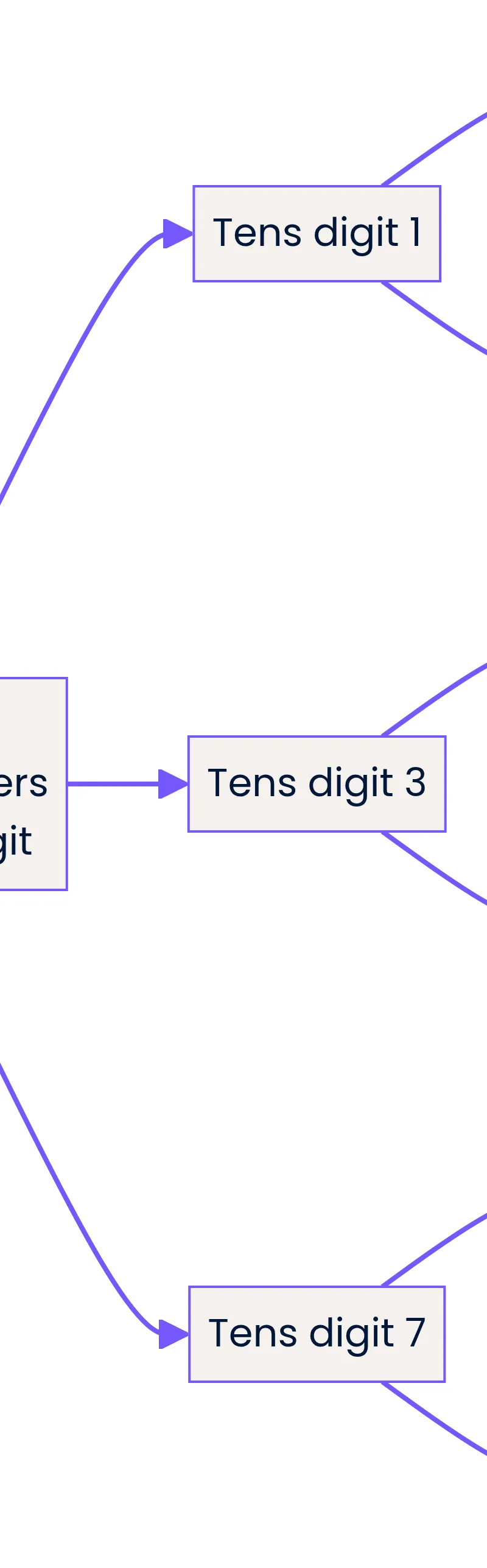
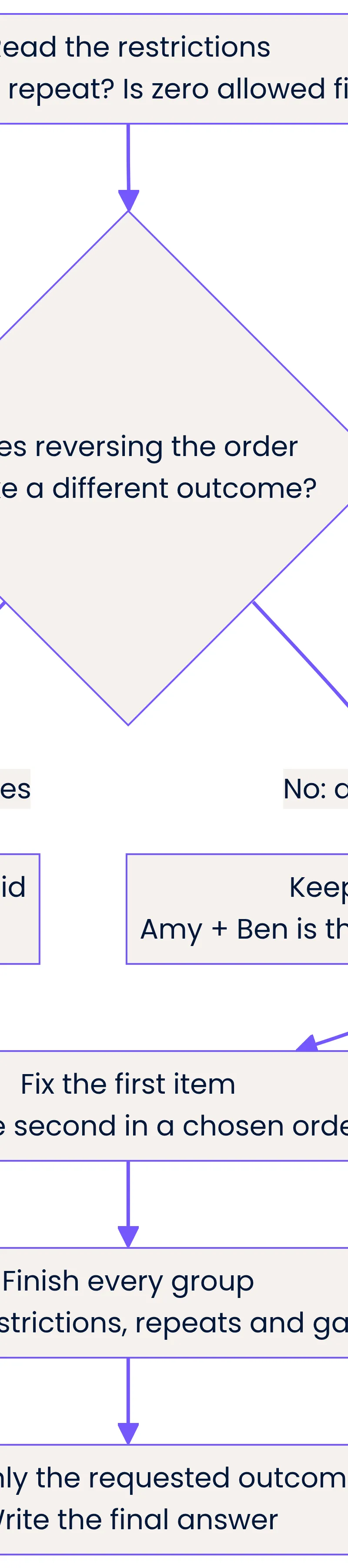
The most useful routine is fix, vary, finish, check. Fix the first item. Vary the second through every allowed option. Finish all the groups, including the final starting item. Check for omissions, duplicates and forbidden cases. Write a short plan such as: 'I will hold the tens digit fixed and list the units digits in increasing order.' This is a helpful habit, not an automatic extra mark.
Why does it work? Every outcome belongs to a particular first-choice group. If every group is present and every allowed second choice appears within its group, there is nowhere for another valid outcome to hide.
Cover and recall: What are the four stages of the routine? Say them before looking back.
Concept 2: Make two-digit numbers by fixing the tens digit
For the digits 1, 3 and 7 without repetition, begin with the smallest possible tens digit. With 1 fixed, the units digit can be 3 or 7, giving 13, 17. With 3 fixed, it can be 1 or 7, giving 31, 37. With 7 fixed, it can be 1 or 3, giving 71, 73.
The finished list is 13, 17, 31, 37, 71, 73. There are six numbers. Each group has two entries because the chosen tens digit cannot also be the units digit. Count the entries, not the digits: 13 is one number, not two outcomes.
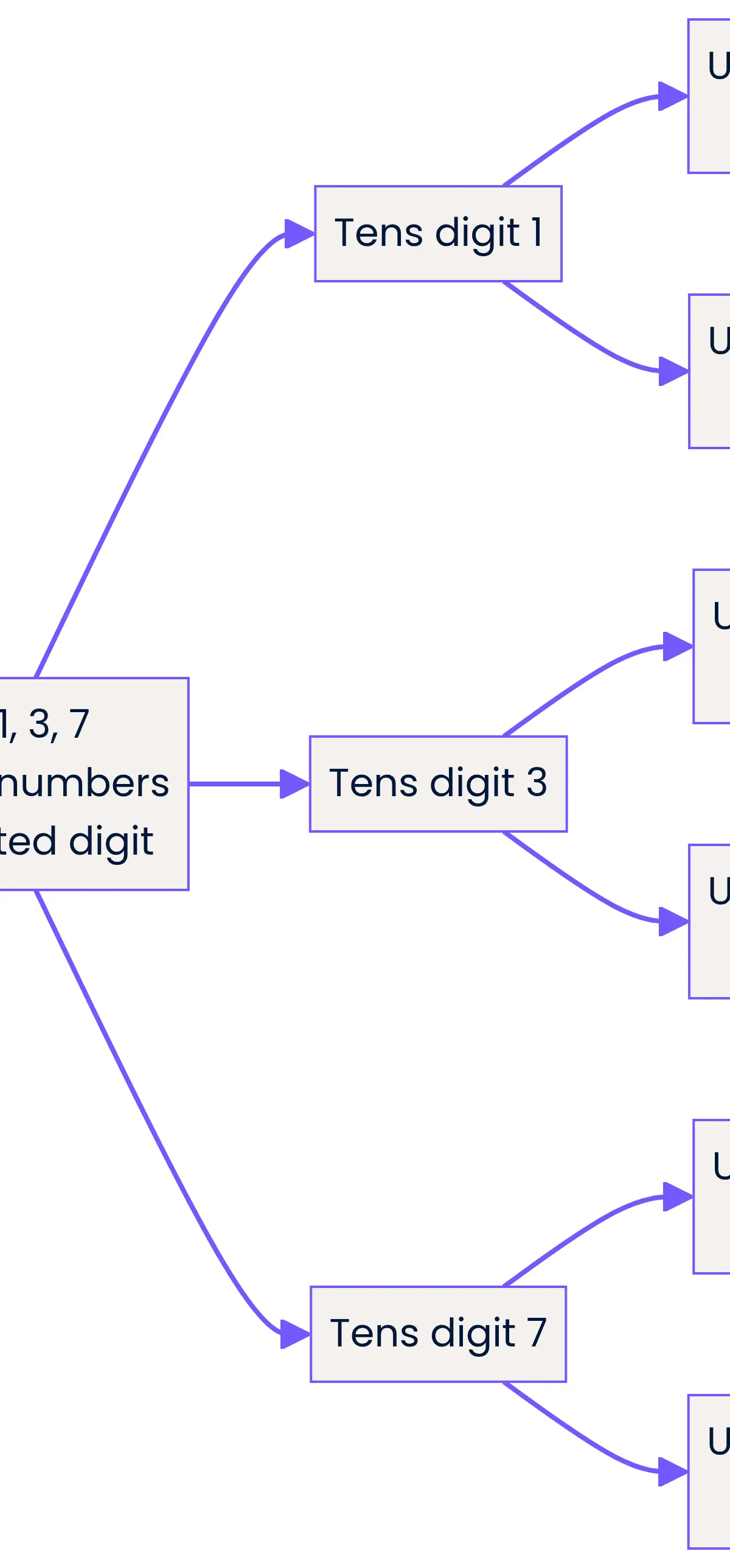
Every complete branch ends in one valid two-digit number. Read the three tens-digit groups from top to bottom.
Candidates do not have to draw a tree if a grouped list is quicker. The diagram explains why the list is complete. In a question requiring every number, writing only '6' does not supply the requested list. Conversely, if the question asks only how many, give a clear total after your working.
Concept 3: Repetition means within one outcome
'Without repeating a digit' means that a digit cannot appear twice within the same number. It does not prevent the digit appearing in other numbers elsewhere in your list. Therefore 13 and 17 may both appear, but 11 is forbidden.
If repetition is allowed, the list changes to 11, 13, 17; 31, 33, 37; 71, 73, 77. There are nine numbers. The added outcomes are 11, 33 and 77. A candidate who includes these in a no-repetition question has answered a different problem.
Treat every restriction as a gate that an outcome must pass. Restrictions might concern repeated items, matching colours, minimum values, or unavailable pairings. Read them before listing rather than trying to repair an unsuitable list afterwards.
What if? If repeats become allowed, which new outcomes appear? Explain the change rather than memorising the new total.
Concept 4: Decide whether order matters
Reversing the entries sometimes produces a different outcome and sometimes does not. 13 and 31 are different numbers, so both count. For two labelled dice, a first-die score of 1 and second-die score of 2 differs from a first-die score of 2 and second-die score of 1.
For an unranked pair of people, Amy with Ben is the same pair as Ben with Amy. Count it once. A useful rule is to write the names alphabetically inside each pair, then vary the second name through those appearing later in the alphabet.
With Amy, Ben, Cara and Dan, write AB, AC, AD; BC, BD; CD. These are six pairs. The groups have three, two and one entries because earlier pairs have already been counted. There is no new group beginning with Dan.
However, choosing a captain and a deputy is different: the roles distinguish the first and second positions. Amy as captain with Ben as deputy is not Ben as captain with Amy as deputy. Never decide whether order matters from the appearance of the letters alone. Decide from the meaning of the question.
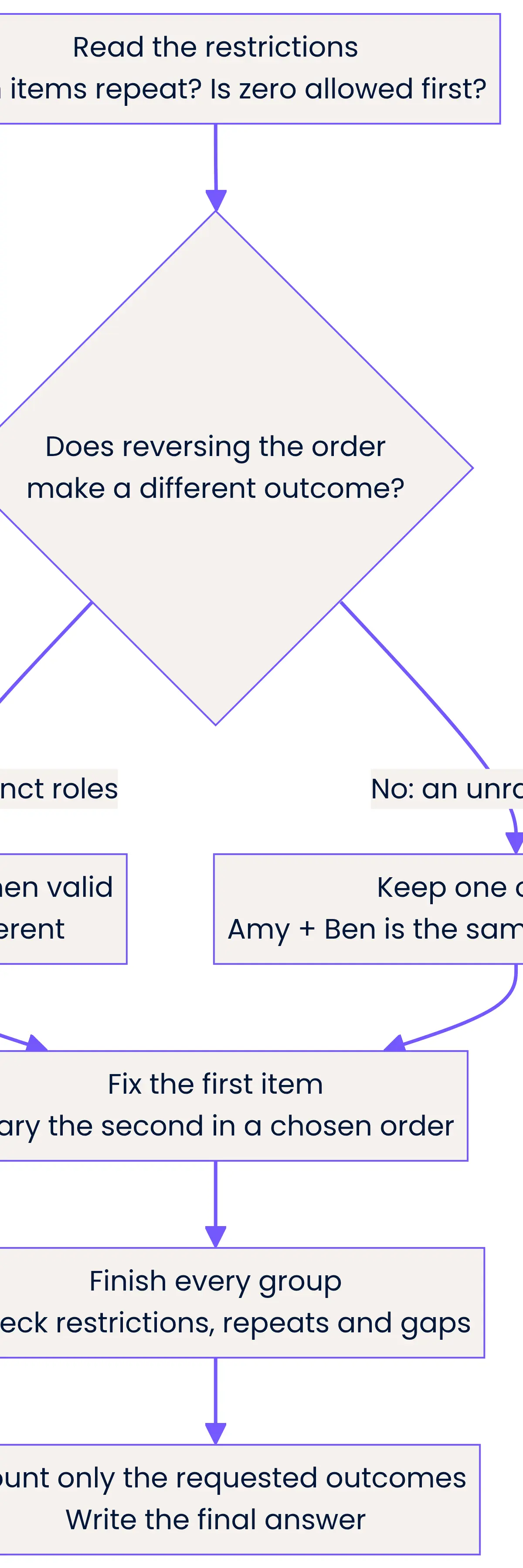
Read the context before deciding whether reversed arrangements should be kept or removed.
Concept 5: Zero can be a units digit, but not a two-digit tens digit
From 0, 2 and 5 without repetition, the valid two-digit numbers are 20, 25, 50, 52. A leading zero does not create an ordinary two-digit number: 02 represents 2 and 05 represents 5.
A two-character code is different. If its rules allow a leading zero, 02 may be a valid code. Distinguish the words 'number' and 'code'. Candidates who automatically discard leading-zero codes, or automatically include leading-zero numbers, overlook the context.
Why is 20 valid? It has two tens and zero units. Why is 02 not a two-digit number? It has zero tens and two units. This is a place-value issue, not a rule that zero is always banned.
Concept 6: Listing choices from different categories
Suppose a cafe offers pasta, curry or jacket potato, followed by fruit or yoghurt. Hold the main course fixed and list both puddings. The six meals are pasta with fruit, pasta with yoghurt; curry with fruit, curry with yoghurt; jacket potato with fruit, jacket potato with yoghurt.
Every group has two entries because each main can be followed by either pudding. If curry cannot be paired with yoghurt, remove that one meal. The new total is five. Do not delete all curry meals or all yoghurt meals.
A shorter group is a warning to investigate, not proof of an error. Equal groups are expected only when the same number of second choices is allowed for every first choice. Unranked pairs and restricted menus naturally produce unequal groups.
Concept 7: Count the requested outcomes, not everything you listed
Some questions ask for all outcomes and then ask about a subset. From 1, 3 and 7 without repetition, there are six two-digit numbers, but only 71 and 73 are greater than 50. The requested count is two.
Underline the final condition. Words such as 'even', 'greater than', 'less than' and 'at least' change which entries count. Even numbers end in 0, 2, 4, 6 or 8. 'Greater than 50' excludes 50; 'at least 50' includes it.
Mark the qualifying entries in your own complete list, then count those marks. Do not restart randomly when a second part introduces a filter. Your existing list is useful evidence and reduces the chance of a fresh omission.
Mathematical/Scientific Relationships
Counting groups
Must memorise: the meaning of a total, not a special listing formula. Add the sizes of the groups. For 1, 3 and 7 without repetition, total = 2 + 2 + 2 = 6. For the four-person unranked pairs, total = 3 + 2 + 1 = 6.
Must memorise: basic multiplication as an equal-group check. Three groups of two entries give 3 × 2 = 6. Use this only when all three groups really contain two allowed outcomes. It is a check, not a substitute when the command word requires a list.
There is no specialised formula-sheet formula required for this Foundation listing skill. Do not wait for one. Pearson's teaching guidance places general product-rule counting under the Higher learning objectives for N5; that extension is outside this guide's core scope. Factorial and permutation notation are unnecessary here. 4
Probability connection
Must memorise for the connected probability topic: P(A) = number of outcomes in A ÷ total number of possible outcomes, provided the individual outcomes are equally likely. Here P(A) means the probability of event A. Listing establishes the numerator and denominator, but probability is a linked application rather than a requirement in every listing question.
Two labelled six-sided dice have 36 ordered score-pairs. A total of 4 occurs for (1,3), (2,2), (3,1), so its probability is 3/36 = 1/12. The totals themselves are not equally likely: there are more ways to make some totals than others.
Practical Applications
Use systematic listing to check outfit choices, menu combinations, small tournament pairings, or short codes. The transferable skill is deciding what counts as a different outcome before counting it. A shirt-and-trousers combination has two different categories. A pair of teammates has no ranking unless the question assigns roles.
There is no required practical, apparatus list or unit conversion for this topic. Counts are whole numbers of outcomes and do not need measurement units. You may write '6 numbers' or '6 meals' to keep the meaning clear.
Reading a sample-space grid
For two dice or two spinners, use one device for row labels and the other for column labels. Each cell represents one ordered outcome. Read whether the cell contains a score-pair, sum or product before interpreting it. Identical sums in different cells are not duplicate outcomes. You are reading a grid, not plotting a continuous graph, so a line of best fit is irrelevant.
Exam Focus
Pearson's official sample Foundation Paper 1, question 11, asks how many numbers can be made using all three tiles 1, 2 and 3. It awards 2 marks: M1 for starting to list combinations and A1 for the correct answer, 6. A systematic list is 123, 132; 213, 231; 312, 321. The June 2025 Paper 3F question 8 scheme awards B2 for nine correct combinations with no repeats, or B1 for at least four correct combinations under its stated conditions. Real allocations vary. The 3–6-mark worked examples below are original multi-part practice with illustrative schemes, not reproduced Pearson papers. 2 3
Each 1MA1 paper is 90 minutes for 80 marks. An average pace is about 1.1 minutes per mark, with some time retained for checking. A simple listing question should not consume time needed for later questions. Show enough working to make your method visible, then move on. 1
A correct count from an incomplete list does not automatically receive follow-through credit. Credit given for method or follow-through depends on the actual scheme. Your safest route is a complete valid list, a justified counting method, and a final answer matching the command word.
Ten-Minute Tutor Podcast
Listen actively: introduction, core concepts, exam tips, quick-fire recall quiz, then summary. Answer the quiz aloud before the tutor gives each answer. Afterwards, rebuild one list without looking. Listening supports revision, but retrieval shows whether you can perform the method independently.
References
Worked Examples
3 worked examples — open one to explore the question and available guidance.
Practice Questions
Try the question, then reveal an answer plan or example response
Use 2, 4 and 9 to make two-digit numbers without repeating a digit. (a) Write down all the numbers. [2 marks] (b) State how many are even. [1 mark]
Hint: Fix 2 first, then 4, then 9. Check the units digit for evenness.
A meal consists of one main, pizza or pasta, and one pudding, fruit, yoghurt or cake. Every pairing is available. (a) List all the meals. [2 marks] (b) State the total. [1 mark]
Hint: Hold the main fixed and list all three puddings before changing the main.
Ali, Bea, Cal, Dee and Eva are available. (a) List all the different unranked pairs of two people. [3 marks] (b) State how many pairs there are. [1 mark]
Hint: Use initial letters. Keep each pair in alphabetical order and let the groups shrink.
Two labelled spinners each have equally likely outcomes 1, 2 and 3. (a) List all ordered score-pairs. [2 marks] (b) State how many pairs have a total of 4. [1 mark] (c) Work out the probability of a total of 4. [1 mark]
Hint: Fix the first spinner. Keep (1,3) and (3,1) because the spinners are labelled.
Use 0, 4 and 7 to make two-digit numbers without repeating a digit. (a) List all the numbers. [2 marks] (b) Explain why 04 is not included. [1 mark] (c) State how many listed numbers are greater than 50. [1 mark]
Hint: Which digits can be in the tens position? Zero is still allowed in the units position.
A two-character code uses 0, 2 and 5. A leading zero is allowed, but a digit cannot repeat within the code. (a) List all codes. [2 marks] (b) State the total. [1 mark] (c) If repetition is allowed, state the new total and explain the increase. [2 marks]
Hint: This is a code rather than an ordinary two-digit number. Keep the zero-first group.
Exam technique
How to turn what you know into marks
How to approach the question
Read the command word and underline all restrictions. Decide whether reversing the order gives a different outcome. Choose a first-choice grouping and complete each group. Check zero, repetition and unavailable combinations. If a further condition is given, select qualifying entries from your finished list rather than beginning again.
How to structure your answer
For a short listing part, write clearly separated groups and include every valid outcome. For a count, state the total after the list or justified counting working. For an explanation, give one precise reason for completeness or duplicate removal. In a multi-part question, label each answer and check the printed mark allocation. Marking is question-specific: official SAM 1F Q11 uses M1 for starting to list combinations and A1 for the correct total, whereas June 2025 3F Q8 uses B2 for a complete nine-combination list without repeats and B1 for at least four correct combinations under its stated conditions. The guide's practice allocations are illustrative, not official schemes.
Timing
Each Edexcel 1MA1 paper has 80 marks in 90 minutes: about 1.1 minutes per mark on average. Aim for roughly 3 minutes on a 3-mark question, 4 minutes on a 4-mark question and 6 minutes on a 6-mark question, retaining some overall checking time. These are revision pacing targets, not official time limits for individual questions.
Common pitfalls
- Random listing hides gaps. Hold the first choice fixed and vary the second in a stated order.
- Stopping before the final group loses valid outcomes. Check every possible first choice.
- Counting AB and BA twice in an unranked pair. Keep names in one alphabetical order within each pair.
- Deleting BA when roles differ. Distinguish an unranked pair from captain-and-deputy appointments.
- Treating no repetition as a ban across the entire list. The restriction applies within each outcome.
- Including 02 as a two-digit number, or discarding it from a code that allows leading zero. Read the context.
- Giving only a count when asked to list all outcomes. Supply the outcomes as well as any requested total.
- Counting 50 as greater than 50, or omitting 58 from an even-number filter. Apply every condition to every entry.
- Assuming any incomplete list or own-list count automatically earns follow-through credit. Only the actual question's scheme determines credit.
What the command words want
- Compare
- If asked, identify how two lists differ, such as the additional repeated-digit outcomes. Use the actual entries as evidence.
- Explain
- Give a mathematical reason: for example, each possible tens digit is paired with every permitted units digit. Use 'because' to justify rather than simply repeat your answer.
- Describe
- If asked to describe a strategy, say which item stays fixed and how the other options are exhausted. This is less typical than list or work out for this skill.
- Evaluate
- Not a usual listing command. In mathematics, evaluate normally means find a numerical value, not write a balanced essay. Follow the particular expression or task given.
- Show that
- Provide enough working to demonstrate the stated result. A systematic list followed by a count may establish the claim.
- State/Give
- Provide the requested number or short statement. Keep any useful supporting list visible.
- Write down/List all
- Supply every valid outcome, with no duplicates. Use unambiguous grouped entries. A total alone does not meet a list-all instruction.
- How many/Work out/Calculate
- Find the requested count, showing a complete list or clear valid counting working. Counts have no measurement units, although a label such as '6 pairs' is helpful.
Watch or listen (optional)
Test your understanding of Number - Structure and calculation: apply systematic listing strategies (Foundation tier)
Active recall beats re-reading. Take an instant quiz now to test what you’ve learned and lock it into long-term memory.
7 days Premium · Then the free plan continues · No card, no charge